Billie and Pierre's Blue Slush Walk
Cœur de slushBillie and Pierre's Blue Slush Walk is an early encounter shaped by a sharp, unstable movement between resistance and invitation. Pierre’s whistling interrupts Billie’s solitary walk to the convenience store; their teasing over a slush and a few personal questions draw them into step together. But when Pierre suddenly says goodbye and disappears down the street, the connection has no clear name or resolution. Billie is left with the image of him receding and the sense that the encounter has already become a memory.
Setting and First Interruption
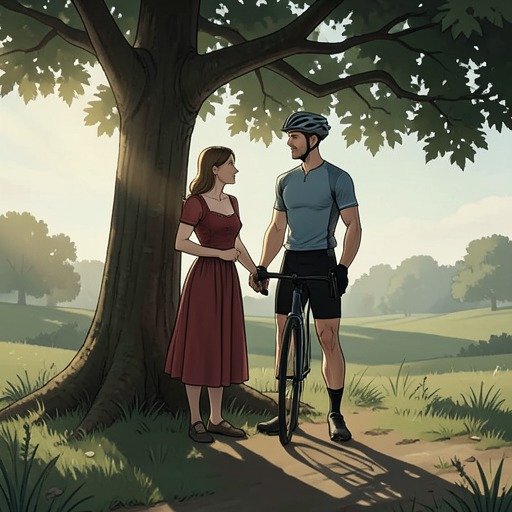
On a hot day, Billie walks toward a convenience store three blocks away, reading a book by Alexandre Jardin. The heat makes her thirsty, and her red dress clings to her thighs in the still air. She is absorbed enough to lose her place in the text and step on a crack when someone’s whistle grows louder. The sound first registers as an annoyance that disrupts her reading; when Billie looks up, Pierre is across the street, walking backward with his hands in his pockets and whistling a Joe Dassin song she likes in summer.
The scene introduces attraction through Billie’s own contradictory attention. She describes Pierre as ugly in a way that makes him beautiful from head to toe, and names the response as love-hate already. The comic exaggeration does not settle the question of what she feels; it establishes that irritation and fascination arrive together. Pierre’s whistle carries the encounter across the street before either of them has begun a conversation.
At the Convenience Store
Billie tries to continue toward the store without engaging, pulling her dress away from her thighs as she walks. Pierre gets ahead of her and opens the door with an arm, a gesture Billie resents as false politeness, especially from him. He follows her inside without speaking, while she chooses a large slush and anticipates having a dark-blue tongue. His attention, meanwhile, is fixed on fluorescent keychains: he argues with the clerk about their price, turning the pause into a small display of his complaints and persistence.
At the counter, Pierre counts out his money slowly. While the clerk calculates the purchase, he turns to Billie and smiles at her with the same eyes she remembers from the previous day. He asks whether she is the other girl’s sister. Billie answers yes, but the question makes her angry: she is being identified through someone else rather than addressed as herself. The exchange gives their banter its edge. Her annoyance is not abstract; it comes from being reduced to a relation when Pierre has her attention as an individual.
Billie lies that she prefers Bryan Adams. Pierre bursts out laughing and continues for a long time, while she does not join him. She tosses two dollars onto the counter and leaves him there, unsure whether he is laughing at something trivial or at her. The moment makes her refusal visible: she can abandon the encounter, take her drink, and return to her book. Outside, the wind has risen enough to lift her red dress, and for a moment she imagines reading and drinking in peace.
From Pursuit to Invitation
Pierre’s footsteps catch up with Billie. He whistles, steps on the sidewalk cracks without concern, and calls for her to wait. Billie stops and tells him that unless he wants to read Alexandre Jardin over her shoulder, there is no reason for him to follow so closely. His response is a cry that she is crazy; he picks up her book while rubbing the tip of his nose. Billie’s breath is heavy, and she describes her heart as wanting to escape her long, noodle-shaped body. The physical intensity of the moment sits beside her sharp verbal challenge: she objects to his closeness even as the encounter keeps her attention fixed on him.
When Pierre asks her name, Billie first says Jacqueline, then admits she is Billie and mocks Pierre’s name as an odd one. Her joking answer opens onto a private uncertainty: she imagines that having a name as unattractive as his might make them equally special, while also affirming that she likes the bee sound in her own name. The exchange is playful, but it shows how quickly Billie turns their names into a possible shared story. She even imagines a title about Pierre and Jacqueline loving and hating each other, making the pair’s contradiction into a miniature romance before the walk has properly begun.
Billie finishes her slush in one draught, freezing her brain and staining her tongue and the corners of her mouth dark blue. Then, with the tips of her toes near the sidewalk, she draws a half-circle with her left foot. The gesture subtly invites Pierre to continue walking with her; he understands and joins her slowly. This quiet movement reverses the earlier pursuit: instead of merely being followed, Billie now signals that she is willing to share the way. To break a silence she dislikes, she asks whether he plays bass. Their conversation proceeds through small, ordinary questions rather than declarations. When Billie asks his favorite color, she names nail-polish red; Pierre answers car yellow. The unremarkable details give the walk its tentative intimacy.
Abrupt Goodbye and Aftermath
The ease does not last. Pierre suddenly stops, loses his smile, and lets out a long sigh. He says goodbye before Billie has time to answer. With his hands back in his pockets, he takes three steps backward while looking at her with a forced smile, then turns away and ruffles his hair, as if offering a hidden salute with the back of his hand. Billie reads the departure as an unacknowledged, perhaps tender moment, but cannot know why he leaves. She wonders whether their questions about favorite colors had made him feel tender; the explanation remains her speculation, not a settled account of his motive.
Pierre walks away whistling Bryan Adams’s “Summer of ’69.” Billie remains standing two blocks from home, her dress moving in the wind and her book dangling from her fingers. She says she understands nothing about him and calls him complicated. As he turns the corner, the present encounter changes in her perception into a Pierre memory. The shift gives the walk its defining ending: it has brought them briefly together, but Pierre’s unexplained retreat makes closeness and loss arrive almost at once. Annette then runs up behind Billie, breathless and wearing a blue dress, and points toward the end of the street, asking whether that was Pierre. Her arrival confirms that the encounter has ended in the street, but does not explain Pierre’s departure.
Narrative Significance
The walk’s emotional pattern is carried by objects and gestures rather than a clear confession. The book begins as Billie’s distraction and becomes a reason to challenge Pierre’s pursuit; the slush colors her mouth while their conversation turns from anger toward play; a half-circle traced with her foot makes her consent to continue legible without words. Against those signs of growing ease, Pierre’s sudden goodbye and forced smile restore uncertainty. The scene does not resolve whether their attraction is mutual or what Pierre wants. Instead, it makes that uncertainty the encounter’s consequence: Billie is left with a vivid, unfinished first Pierre-moment, already receding into memory.